Quick Answer: What Is the Cost of Retrieval in SEO?
Cost of Retrieval in SEO means how much effort Google needs to find, understand, and show your content to users. If your website content is clear, well-structured, and semantically organized, Google uses less resources to process it.
What are two types of retrieval?
1. Recall
2. Recognition
Lower Cost of Retrieval = better crawling, faster understanding, and higher ranking potential.
In Semantic SEO, not everything is about keywords or content length. It is also about cost.
According to Koray Tugberk GUBUR, Cost of Retrieval explains how expensive a website is for Google to crawl, index, and rank from a computational perspective. This cost is not money. It is the effort Google needs to process your website.
In one real project shared by Koray Tugberk, a website had millions of URLs but very low search demand. Because of this imbalance, Google intentionally kept the index size small and ignored many pages.
At the same time, the site had many wasteful URLs, server errors, and old 404 pages. This increased crawl cost and diluted ranking signals across the website.
Koray explains that more URLs do not mean better rankings. More URLs often mean less PageRank per page, higher crawl cost, and higher retrieval cost for each URL.
When the website was cleaned and unnecessary URLs were removed, impressions, clicks, and ranked queries started to grow steadily.
This shows a simple truth.
If your website is expensive for Google to retrieve, it will not rank well, even if your content looks good.
That is why understanding the cost of retrieval in SEO is critical today. Especially in Semantic SEO, Google prefers websites that are easy to retrieve, easy to understand, and efficient to evaluate.
This article will help you understand that concept in simple terms and show how cost of retrieval affects rankings, crawling, and visibility.
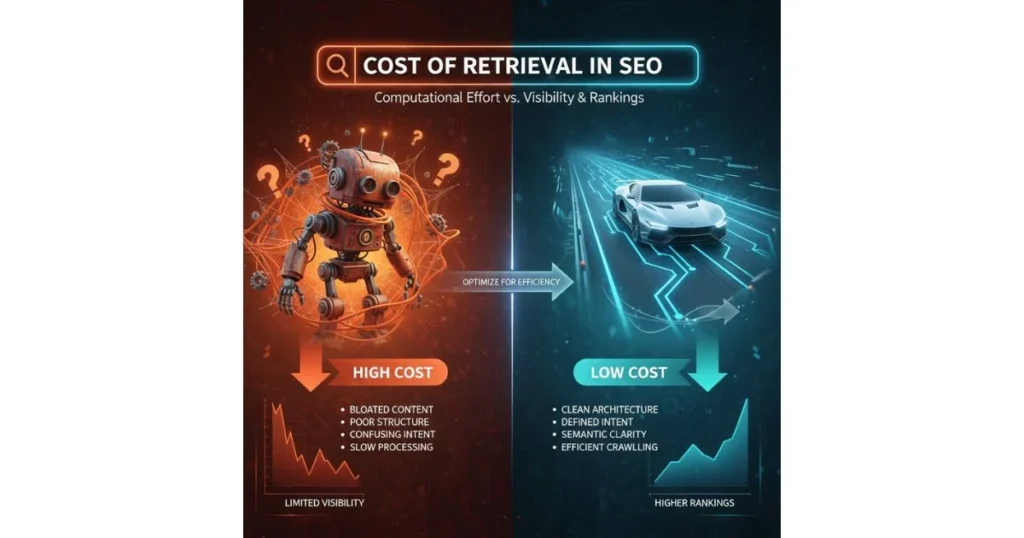
What Is Cost of Retrieval in SEO
Cost of retrieval in SEO explains how much effort Google Search needs to reach, process, and use a web page. This concept comes from information retrieval systems, which are the foundation of modern search engine algorithms.
Cost of retrieval is not a money cost.
- You do not pay Google for it.
- It is a computational cost.
- It means how much processing power Google uses to handle your content.
From a search engine perspective, every page has a cost. Some pages are easy to process. Some pages are expensive. Google prefers pages that are cheap to retrieve and easy to understand.
How Google Processes a Page
Google follows a clear system.
- First, Google crawls the page.
- Then, Google indexes the page.
- After that, Google tries to understand the content.
- Finally, Google serves the page to users.
This crawl, index, understand, and serve workflow decides the cost of retrieval meaning for your website.
- If your content is clear, the cost stays low.
- If your content is confusing, the cost becomes high.
Why Cost of Retrieval Becomes High
Cost of retrieval in SEO increases when
- Google needs more time to understand the topic
- Pages lack clear meaning
- Content does not match search intent
- The website structure is weak
These problems reduce crawl efficiency and raise indexing cost during search engine processing.
Role of Semantic SEO
Semantic SEO helps Google understand meaning, not just words. When meaning is clear, query processing becomes faster. When query processing is fast, content understanding improves. This lowers the cost of retrieval.
This is why semantic SEO is critical in modern SEO and AI based search systems.
Why Clients Face Ranking Problems
Many clients say, My content is not ranking, but I do not understand why.
In most cases, the issue is not backlinks or tools. The issue is that the website is expensive for Google to retrieve.
When a page costs too much to process, Google limits crawling, indexing, and visibility. That is why understanding what is cost of retrieval in SEO is essential for long term rankings and sustainable growth.
This concept is actively used in modern semantic SEO strategies and AI driven search systems, where efficiency, clarity, and meaning decide visibility.
Cost of Retrieval vs Common Misconceptions
Cost of retrieval in SEO is often misunderstood. Many SEO clients invest money in the wrong areas because they do not understand what this concept really means.
The cost of retrieval is not the hosting cost. A fast server alone does not make your site easy for Google. Hosting helps speed, but speed is only one small part of the process.
The cost of retrieval is not SEO agency fees. Paying more for backlinks, tools, or content does not reduce retrieval cost if the site structure and meaning are weak.
The cost of retrieval is not page speed only. Page speed helps users, but Google also cares about how efficiently it can crawl, index, and understand your pages.
This confusion creates serious SEO misconceptions and ranking myths.
Where SEO Clients Make the Wrong Investment
Many clients believe
- more backlinks equals higher rankings
- more pages equals more traffic
- more keywords equals better SEO
But this thinking ignores internal ranking signals and algorithmic efficiency.
According to Behzad Hussain, business owners often ignore overall website quality. He calls this fatal. A website can look active but still be expensive for Google to retrieve. When overall quality is low, cost of retrieval increases, and rankings suffer.
Koray Tugberk GUBUR confirmed this point, showing that understanding cost from Google’s perspective is critical, not optional.
Why More Pages Can Hurt You
Muhammad Qasim highlighted a common SaaS problem. Many founders believe more pages mean more traffic. In reality, too many low value or wasteful URLs cause ranking signal dilution. This increases retrieval cost and suppresses your best pages.
More URLs mean:
- less PageRank per page
- higher crawl cost
- higher retrieval cost
This is why cleaning wasteful URLs often unlocks growth.
Large Sites Suffer the Most
Attiq Haroon pointed out that cost of retrieval is underestimated on large and aging websites. Adding more content does not help when structure, entities, and categories are weak. Tightening entity focused pages and removing URL waste is often the real growth lever.
Omer Ashkenazi added that many teams ignore crawl budget until it is too late. Cleaning redirects and waste URLs is usually the fastest way to improve rank ability. Cost of retrieval is simple, but most teams never apply it in practice.
The Core Truth
Many sites fail because they optimize tactics, not understanding.
- They chase keywords.
- They buy links.
- They publish more content.
But they ignore how Google processes their website.
Cost of retrieval in SEO is about how easy your site is for search engine algorithms to evaluate using information retrieval systems. When your site is expensive to process, Google limits crawling, indexing, and visibility, no matter how much money you spend elsewhere.
Understanding this difference is the first step toward real semantic SEO growth.
How Cost of Retrieval Impacts Rankings, Crawling and Visibility
Google always prefers pages that are cheap to retrieve. This is not about preference in a human sense. It is about efficiency. Search engines must manage resources, and low cost pages allow Google to serve better results at scale.
When the cost of retrieval is low, Google can crawl more pages, index them faster, and trust the content sooner. When the cost is high, Google slows down or limits access.
Why Google Prefers Low Cost Pages
Googlebot crawls billions of pages every day. It must decide where to spend time. Pages that are easier to interpret and reuse require less processing. This is why Google prioritizes them.
Low cost pages
- get crawled more often
- get indexed more reliably
- get evaluated more frequently
High cost pages
- get crawled less
- get delayed indexing
- get limited visibility
This directly affects rankings.
Crawl Budget and Indexing Problems
Every website has a crawl budget. This is not fixed, but it is limited.
When crawl budget is wasted on
- duplicate pages
- old URLs
- redirect chains
- thin content
Google reduces crawl frequency on important pages. This leads to indexing issues.
This is why many clients say:
- Pages are not indexed
- Content updates do not change rankings
The problem is not the content update. The problem is that Google is not reprocessing the page due to high retrieval cost.
Impact on SERP Visibility
Search Engine Results Pages reward stability and clarity. Pages with low retrieval cost are easier to re evaluate and reuse across search results.
- This improves
- SERP visibility
- ranking consistency
- crawl frequency
Pages with high retrieval cost stay unstable or invisible.
Impact on AI Answers and Featured Results
AI Overview and featured snippets rely on content that is easy to understand and reuse.
Google selects pages that:
- clearly answer questions
- have stable meaning
- are efficient to process
If your page is expensive to retrieve, it is less likely to appear in AI answers, even if the content looks correct.
What This Means for Clients
If your pages are not indexed or rankings do not change after updates, the issue is often not effort or quality. It is cost.
Understanding how the cost of retrieval affects rankings helps explain why visibility stalls and why some pages never reach their potential. Google rewards efficiency before expansion.
Real Life Example High vs Low Cost of Retrieval Website

Google does not crawl your entire website. It never did. And in most cases, the reason is your structure.
Many SEO teams celebrate publishing hundreds of pages. At the same time, Googlebot is crawling a small portion of the site and ignoring the rest. This happens because the website becomes expensive to retrieve.
High Cost of Retrieval Website
A high cost website usually looks like this.
- The structure is bloated.
- Too many pages exist to cover the same idea.
- Internal linking is weak or random.
- Content is written for keywords, not for intent.
These sites create thousands of URLs to compete with competitors who rank with far fewer pages. The result is content bloat. Cost of retrieval increases, but ranking potential does not.
Google sees:
- more pages to crawl
- more pages to render
- more pages to store
When the cost of ranking your site becomes higher than the cost of ignoring it, Google stops investing resources.
Low Cost of Retrieval Website
A low cost website is built around clarity.
- The structure is clean.
- Pages are connected by meaning.
- Each page has a clear purpose.
- Internal linking supports understanding, not volume.
One real comparison shows this clearly. Site A had more pages, stronger entity connections, and higher accuracy across connected topics. Site B had fewer pages, weaker connections, and lower topical clarity.
Site A ranked better every time. Not because it had more content. But because its information architecture made it cheaper for Google to understand and trust.
Why Intent Beats Keywords
Keyword stuffed pages increase retrieval cost. Intent focused pages reduce it.
When content answers a real question and fits clearly into a topical graph, Google can process it faster. This improves trust and visibility.
This is why competitors outrank you. Not because they publish more. Because their semantic structure reduces cost.
The Client Realization Moment
At this point, many site owners say, Oh this is exactly what is wrong with my site.
They realize the problem is not effort. It is inefficient.
- The future of SEO is not about content volume.
- It is about semantic clarity.
- It is about retrieval efficiency.
- It is about building a site that is cheap to understand and impossible to ignore.
Best Practices to Reduce Cost of Retrieval
Reducing cost of retrieval in SEO is not about doing more. It is about removing friction.
Search engines reward sites that are easy to process, easy to connect, and easy to reuse. This requires intentional structure, not random optimization.
Build Semantic Content Structure
Start with meaning. Not keywords.
Group content by topic, not by search volume. Every page should support a main subject. This creates semantic optimization that lowers processing effort during retrieval.
When Google sees clear topical boundaries, it spends less time figuring out what belongs where.
Define Clear Page Intent
Each page must answer one main question.
If a page tries to rank for multiple intents, cost increases. Google needs extra processing to decide how to classify it.
- Clear intent reduces ambiguity.
- Less ambiguity reduces retrieval cost.
This is one of the most ignored SEO best practices.
Link Pages by Topic
Internal linking should follow logic, not chance.
Pages that belong to the same topic should connect naturally. This helps search engines move through the site with fewer decisions.
Topic based internal linking improves crawl flow and reduces wasted processing.
Eliminate Duplicate and Thin Content
Duplicate content increases retrieval cost without adding value. Thin pages force Google to re-evaluate meaning without learning anything new.
Both are expensive. Removing or consolidating them is one of the fastest ways to reduce cost of retrieval.
Use Professional Tools Correctly
Professionals do not guess.
They use Google Search Console to identify indexing gaps, crawl behavior, and coverage issues. Crawl analysis helps find wasteful URLs and structural friction.
Schema Markup adds explicit meaning. It reduces interpretation effort and improves reuse across search features.
These tools do not rank your site by themselves. They help you make your site cheaper to retrieve.
The Core Principle
If you want to know how to reduce cost of retrieval in SEO, focus on clarity, structure, and intent. When your site becomes efficient to understand, rankings follow naturally.
Common Mistakes SEO Clients and Agencies Make
Most SEO failures are not caused by Google updates. They are caused by misunderstanding how search engines work.
- Many clients spend money.
- Many agencies deliver activity.
- But results do not follow.
The reason is simple. They increase effort without reducing cost.
Over Optimizing Keywords
Keyword over optimization is one of the oldest SEO mistakes, and it still happens every day.
- Pages are written to include keywords multiple times.
- Headings are forced.
- Sentences lose meaning.
From a search engine view, this creates noise. Not clarity.
When Google processes such pages, it needs extra effort to separate meaning from repetition. This increases retrieval cost and creates ranking issues.
Search engines do not reward pages that repeat words. They reward pages that explain concepts clearly.
This mistake usually comes from an algorithm misunderstanding. SEO is treated as a formula instead of a system.
The 80/20 rule (Pareto Principle) in SEO states that roughly 80% of organic traffic and conversions result from 20% of a website’s pages or keywords.
Publishing Content Without Topic Relevance
Another common mistake is publishing content just to increase volume.
Many sites publish articles because
- a keyword looks easy
- a tool shows traffic
- a competitor has a page
But the content does not belong to the site’s main topic. This breaks topical coherence.
Google tries to understand what a site is about as a whole. When pages do not connect semantically, the site becomes harder to interpret.
The result:
- higher retrieval cost
- lower trust
- weaker rankings
This is why some sites publish hundreds of articles but see no growth.
Ignoring Site Architecture
Site architecture is often ignored because it is invisible.
- Clients see content.
- They see backlinks.
- They do not see structure.
But search engines see structure first.
- Poor architecture forces Google to make too many decisions.
- Which page is important
- Which page supports which topic
- Which page should be crawled more often
This confusion leads to crawl inefficiency and ranking instability.
Agencies often avoid this problem because fixing architecture takes planning, not tools.
The Real Pain for Clients
Clients usually feel two things. Money spent with no return. Dependence on agencies without clarity.
- They see reports.
- They see tasks.
- They do not see progress.
This happens when SEO focuses on tactics instead of understanding how ranking systems evaluate cost, trust, and efficiency.
How to Evaluate If Your Website Is Expensive for Google to Retrieve
You do not need advanced tools to see warning signs. High cost of retrieval leaves clear signals.
Pages Not Indexed
One of the strongest signs is indexing issues.
You publish content. But pages do not appear in search.
This is not always a quality problem. Often, it is a cost problem.
Google limits indexing when processing becomes expensive. It chooses where to spend resources.
Low Impressions Despite Content
Another sign is low impressions.
- Your content exists.
- It is relevant.
- But it rarely appears.
This means Google is not confident enough to reuse it across queries. Reuse requires low retrieval cost.
If Google cannot easily interpret and trust a page, it limits exposure.
How to Check Cost of Retrieval
To understand how to check cost of retrieval, professionals start with Google Search Console.
- They review
- indexing status
- crawl behavior
- coverage issues
The Index Coverage Report shows which pages Google accepts and which it avoids.
Crawl errors and repeated exclusions often point to structural inefficiency.
This is not about fixing one error. It is about understanding why Google avoids processing your site deeply.
Cost of Retrieval vs SEO Service Costs
This section is often missing. And it causes confusion. SEO service costs are what you pay agencies or freelancers.
Cost of retrieval is what Google pays to process your site. These two are not the same.
Paying more does not reduce retrieval cost. Spending less does not increase it. SEO services exist to reduce cost of retrieval indirectly.
- By improving structure.
- Clarity.
- Semantic alignment.
When clients understand this difference, expectations become realistic.
SEO is not about buying rankings. It is about making your site efficient enough to deserve them.
This clarity often changes sales conversations. It removes confusion. It builds trust.
Final Authority Statement
Semantic SEO is not a trend. It is an efficiency model.
Search engines are becoming more intelligent, but also more selective. They invest in sites that are cheap to understand and easy to reuse.
Lower cost of retrieval leads to higher trust. Higher trust leads to better visibility.
This concept matters more in AI driven search than ever before. The future belongs to websites that reduce friction, not those that create more noise.
Learn More: HAMIMIT.COM
Learn More About Boosting SEO with Cost-of-Retrieval Optimization
Video: Technical SEO & Semantic SEO with Koray Tugberk Gubur

Custom Web & Holistic SEO Strategist | Fixing Slow, Low-Converting Websites to Drive High-Ticket Leads & Organic Sales (Without Ads) Managing Director at HAMIM-IT
I help businesses fix underperforming websites and weak Google visibility, turning slow, outdated platforms into high-converting digital assets that consistently generate qualified, high-ticket organic leads (without relying on ads)